Get Out of Bed (GOOB): A Proactive, AI-Enabled Somatic Intervention for Heavy Mornings

RELEVANT TO: PERSONAL ROBOTS, FLUID INTERFACES, CYBORG PSYCHOLOGY

PERSONAL PROJECT (IN PROGRESS)


Get Out of Bed (GOOB): A Proactive, AI-Enabled Somatic Intervention for Heavy Mornings

PERSONAL PROJECT (IN PROGRESS)

THE CHALLENGE

Explore how an AI system can help people initiate action during emotionally difficult mornings—when motivation, executive function, and self-regulation are impaired—without relying on willpower, screens, or intrusive prompts.

ROLE

Founder (doing Conversation Design, User Research, & Prototyping)

THE OUTCOME

A proactive, voice-based AI companion that guides users through a staged transition from lying in bed to embodied action—sitting up, standing, and completing one small, grounding morning task. The system uses emotionally attuned language and somatic micro-interventions to reduce friction and help users begin their day without overwhelm, dread, or stress.

RELEVANCE TO PERSONAL ROBOTS: GOOB aligns closely with the Personal Robots group’s focus on health and wellness by exploring how an proactive AI companion can support daily wellbeing behaviors at moments of vulnerability. Rather than optimizing performance or productivity, this work examines how a personal agent can gently scaffold action—helping users transition from rest to movement when emotional and cognitive resources are depleted. Like other health-focused personal robotics work, GOOB treats wellbeing as an ongoing, relational process embedded in everyday routines rather than a one-time intervention.

RELEVANCE TO FLUID INTERFACES: GOOB directly engages with Fluid Interfaces’ exploration of emotionally adaptive, context-sensitive systems that respond to human internal states. Similar to projects such as the Wearable AI System for Predicting Everyday Behavior, Mood-on-the-Move, and Emotional Self-Voice, this work treats emotion not as an input label but as a dynamic signal that shapes interaction pacing, language, and intervention intensity. The system’s voice-first, screen-minimal design echoes research in SomaSync and Mirai, emphasizing embodied transitions, somatic cues, and gentle temporal coordination rather than explicit instruction. GOOB also relates to the MIT–OpenAI longitudinal study on AI and well-being by exploring how emotionally attuned AI interactions influence users’ emotional regulation, motivation, and reliance patterns—without encouraging dependency or emotional substitution.

RELEVANCE TO CYBORG PSYCHOLOGY: GOOB contributes to Cyborg Psychology by investigating how humans psychologically integrate AI systems into moments of self-regulation, motivation, and bodily action. Like the Wearable Reasoner project, this work explores contextual awareness—not through sensors alone, but through conversational and emotional inference—to support wellbeing decisions in situ. The project raises core cyborg psychology questions about dependency, autonomy, and agency: how much support helps without replacing internal regulation, and how AI can function as a temporary cognitive–emotional scaffold rather than a substitute for human capability. GOOB treats the human–AI system as a coupled unit during moments of difficulty, while explicitly designing for eventual disengagement and user self-sufficiency.


For people experiencing burnout, depression, grief, or overwhelm, the hardest part of the day is often the first 60–90 seconds after waking. Traditional alarms ignore emotional state, rely on screens, and assume cognitive motivation—failing precisely when the nervous system is dysregulated. Existing mental-health tools require users to initiate help, articulate feelings, or engage cognitively at moments when that capacity is lowest.

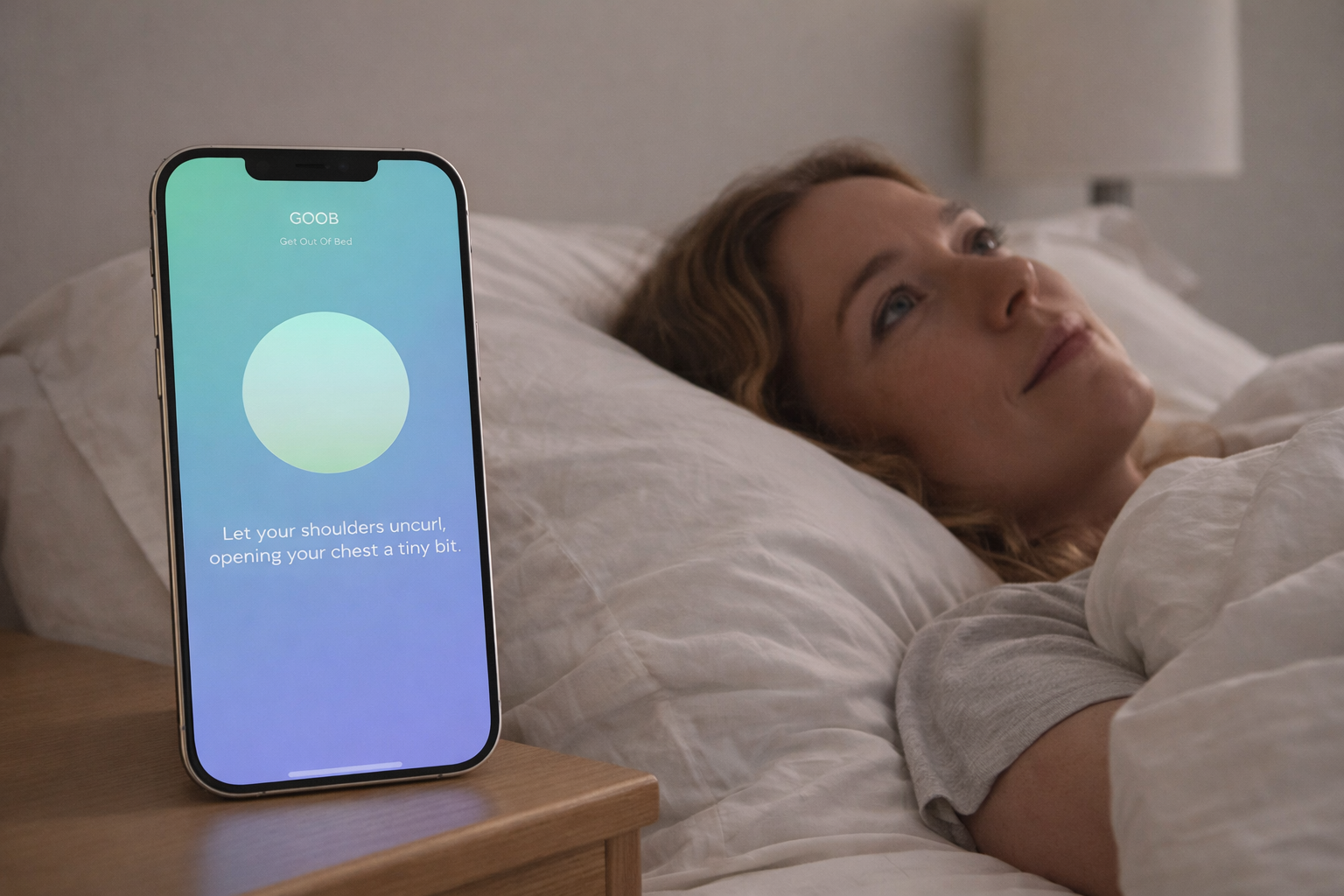
Get Out of Bed (GOOB) is a voice-first, emotionally attuned AI companion designed to help users transition from waking to action through gentle somatic guidance and contextual emotional support. Rather than therapy or motivation, the system focuses on embodied activation: move from lying in bed to sitting up, standing, and ultimately completing one small, meaningful morning action (e.g., drinking water, opening blinds) when they feel “stuck.”

How It Works
At wake time, GOOB initiates a short voice interaction that:

  • checks in on how the user is feeling

  • classifies emotional friction into one of six categories (burnout, grief, overwhelm, depression, stress, or dread)

  • delivers a brief, trauma-informed somatic micro-sequence appropriate to that state to guide the user from lying → sitting → standing

  • supports completion of a single morning action

The system combines a structured state machine, rule-based NLU for safety-critical detection (e.g., crisis language), and an LLM for empathetic, context-sensitive responses. Tone, pacing, and boundaries are deliberately constrained to avoid over-dependence, clinical framing, or toxic positivity.

This work is still in progress, but I will be measuring: morning activation rate, morning engagement rate, emption classification coverage, completion rate, interruption handling accuracy, session duration, safety trigger rate, and return rate—designed to evaluate whether gentle, proactive AI can reliably support initiation and follow-through without increasing cognitive load. Early prototyping demonstrates feasibility of low-friction voice interaction, emotion classification coverage, and safe handling of distress and interruptions within a 3–5 minute session.

Why this work matters: GOOB explores a critical but under-studied moment in human–AI interaction: when people lack the capacity to seek help but still need support. The project contributes a novel design paradigm for proactive, emotionally responsible AI—one that combines somatic psychology, conversational interaction, and strict ethical boundaries to support human agency rather than replace it. This work directly informs research on contextual inference, embodied AI, and human flourishing, with implications for mental health, wellbeing, and everyday human–AI collaboration.